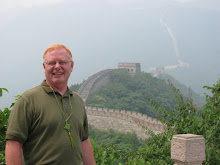
Nancy and I have been married 31 (and a bit) years - the first and only marriage for both of us. We met in the summer of 1976 at university, and married in 1979 at the start of Nancy's 4th year, which was mid-way through my final year.
I have a very patient wife - some might say that only a very patient person could stay married to me, especially for that long. The most recent test of her patience was watching the bank account drain as I worked through fulfilling my life-long dream of earning my pilot license. But it was my dream fulfillment, and she agreed to the commitment at the start of the journey, so she saw me through it.
The classic question, asked mid-way during 2009: "So, once you get this thing, what are you going to do with it?"
"Why, go flying of course - we are going to go flying."
Fast-forward to January 30 2010, when we scheduled our first flight.
It was appropriate that Nancy would be my first passenger. Technically the flight test examiner is the first passenger, though that designation is there primarily to make it clear that the Transport Canada examiner is not there in a role as a pilot or as an instructor and therefore the PIC is the examinee - all of which is there for liability limiting reasons. Maybe it would be best to call her my first passenger of choice.
And so discussions started. Where do we want to go? What do we want to see? How long do we want to fly? Is this going to be a breakfast flight to a destination, or a sight-seeing flight around the area?
I asked another pilot and instructor at the club, Tony Hunt, about airports within a decent distance that had decent food. Most of the restaurants are of the greasy-spoon variety, and breakfast flights are better in the summertime anyway.
So Nancy and I decided on a local sight-seeing flight, over familiar landmarks, not too long or complex, with lots of novelty.
As always, I had my own objectives for this first flight:
Flight planning was Friday night. The weather was going to be clear though frightfully cold, the winds were going to be minimal, the jet stream was not overhead, so it was looking like a day with great visibility and minimal or no turbulence.
Route selection was to be local. We live on the west end of Ottawa, and so the route was to be a loop on the northwest side. Once I calculated the total flight time I removed the final leg, there is such a thing as too-much, especially on her first long flight.
Saturday morning: Sky clear, winds were 300 light, temperature was -22C, 30.34". With a density altitude of -5026 feet, the C172 was going to climb like a homesick angel. The club's limitation was a minimum temperature of -25C. Definitely a day to wear layers, especially long underwear (which I wear for every winter flight anyway).
The selected route:
Radio:
Done well:
Lessons learned:
Overall, it was an excellent flight. Nancy enjoyed the eye-candy out the window. Flying over our house was an excellent idea. I did not frighten her. Her comfort grew as the flight moved along, and she was comfortable with looking straight down out the window. Same as being a passenger in the car, she likes to have a map on her lap.
Apparently, she believes I can fly safely. She'll come flying with me again.
It's great to do things as a couple.
I have a very patient wife - some might say that only a very patient person could stay married to me, especially for that long. The most recent test of her patience was watching the bank account drain as I worked through fulfilling my life-long dream of earning my pilot license. But it was my dream fulfillment, and she agreed to the commitment at the start of the journey, so she saw me through it.
The classic question, asked mid-way during 2009: "So, once you get this thing, what are you going to do with it?"
"Why, go flying of course - we are going to go flying."
Fast-forward to January 30 2010, when we scheduled our first flight.
It was appropriate that Nancy would be my first passenger. Technically the flight test examiner is the first passenger, though that designation is there primarily to make it clear that the Transport Canada examiner is not there in a role as a pilot or as an instructor and therefore the PIC is the examinee - all of which is there for liability limiting reasons. Maybe it would be best to call her my first passenger of choice.
And so discussions started. Where do we want to go? What do we want to see? How long do we want to fly? Is this going to be a breakfast flight to a destination, or a sight-seeing flight around the area?
I asked another pilot and instructor at the club, Tony Hunt, about airports within a decent distance that had decent food. Most of the restaurants are of the greasy-spoon variety, and breakfast flights are better in the summertime anyway.
So Nancy and I decided on a local sight-seeing flight, over familiar landmarks, not too long or complex, with lots of novelty.
As always, I had my own objectives for this first flight:
- Make sure Nancy had an excellent experience. After all the investment of time and effort and money, I did not want this to culminate in one flight which freaked her out, and as a result we'd never fly together again. Smooth, simple, safe, well-explained and no-surprises would be the key criteria.
- I wanted to fly with precision - holding altitudes, holding headings, final approaches which were stabilized early. In other words, make it look easy and build her confidence.
- Build my confidence. Just as with any important event, nerves were going to be a factor for me. But I have a decent number of hours, I know how to fly an airplane, I can do this, so quit worrying about it and just go do it.
Flight planning was Friday night. The weather was going to be clear though frightfully cold, the winds were going to be minimal, the jet stream was not overhead, so it was looking like a day with great visibility and minimal or no turbulence.
Route selection was to be local. We live on the west end of Ottawa, and so the route was to be a loop on the northwest side. Once I calculated the total flight time I removed the final leg, there is such a thing as too-much, especially on her first long flight.
Saturday morning: Sky clear, winds were 300 light, temperature was -22C, 30.34". With a density altitude of -5026 feet, the C172 was going to climb like a homesick angel. The club's limitation was a minimum temperature of -25C. Definitely a day to wear layers, especially long underwear (which I wear for every winter flight anyway).
The selected route:
- CYRO R27, clearing to the west. Fly alongside the Gatineau hills at 2200', providing Nancy with a nice view of the lookouts in Gatineau Park.
- Turn southwest, fly over Constance Bay to Carp (CYRP). Point out the landforms and towns around CBay, Constance Lake, etc.
- Descend from 2200' to 1400' over the town of Carp. Fly over the airfield to join the mid-left downwind to a stop&go. Carp is a quiet airport situated in farmland, so it has lots of airspace and not much traffic, a good place to practice circuits with no pressure. I wanted Nancy to see landings, since to an inexperienced passenger seeing the approaching ground get larger through the windscreen is usually one of the more stressful aspects of flying.
- Backtrack R28. To highlight the performance of the aircraft (and to practice my skill), I briefed her on the short-field take-off technique. No obstacle-clearance required, since I didn't want to surprise her with the extreme nose-up attitude. She was impressed with how quickly we were airborne.
- Climb straight-out to 1400', circle left to a southeast heading, clear CYRP frequency and talk to Ottawa Terminal, requesting 2000' over Stittsville (our town) then west to Carleton Place for sightseeing. Approved by terminal, I did an enroute climb.
- Over Stittsville I pointed out a few landmarks, such as the neighbourhood school and the shopping plaza near our house. Nancy traced streets until she figured out where we lived. Pictures were taken.
- Westbound to Carleton Place. Nancy had the map on her lap, and was correlating landmarks to the map (the world looks very different from even a bit of altitude).
- Just west of Stittsville to floor of Terminal's airspace changes from 1500' to 2500', radar coverage terminated, and we switched to enroute 126.7. Nancy was relieved, since the radio traffic on Terminal's frequency was constant, and overwhelming her.
- Highway 7 is being rebuilt to 4 lanes, between the 417 and Carleton Place, and so she was quite interested in trying to figure out the new routing.
- Just short of CP I turned north, to track along the Mississippi River.
- Almonte is a great little town (childhood home of James Naismith, inventor of basketball). Nancy didn't figure out which town it was until she cross-correlated with the map (and I pointed out the water tower with the big black letters on the side).
- Just past Almonte the floor of CYOW's airspace rises from 2500' to 6500', so I climbed to 2800' in anticipation of over-flying Arnprior's airport.
- Flew past Packenham, between the town and the ski hill.
- Just east of Arnprior airport (CNP3) we turned northeast, entered the practice area and climbed to 3950' to maximize visibility of Gatineau Park. Told Nancy we were headed to Wakefield to see the covered bridge.
- Pointed out Meech Lake under the right wing - a very long and narrow lake in Gatineau Park. We've taken the kids swimming there in previous summers.
- Nancy asked where the covered bridge was located. I told her "look right over the nose", reduced throttle and pushed the nose down - and there it was.
- Descended to 3000' in a slow descending sweeping turn to the right, so she could have a good look at Wakefield and at the bridge.
- Flew over the Mont Cascades ski hill. Nancy wanted to have a look at the hill, so I told her to take the yoke and turn it slightly to the left, so we would not fly directly over the hill. Nancy redefined the word "gentle" in a gentle turn. Who knew a C172 would turn with 3 degrees of bank.
- I took control, dropped the right wing a little so she could see the ski hill. "Oh, that's neat, there is a red helicopter taking off from the ski hill." This observation was made while looking almost straight down, so the heights were clearly not bothering her. We didn't hear any radio calls from the Medevac helicopter, but I made my position reports on frequency. I expect they have TCAS anyway.
- Enroute descent to 1700' over the Chelsea dam, flying south down the east side of the Gatineau River. Casino and the Parliament buildings were straight ahead.
- Pre-landing checks complete, landing briefing complete, descend to 1200' and join the straight-in left downwind for CYRO.
- Normal landing R27.
Radio:
- This was a busy flight. CYRO - practice area - CYRP- Ottawa Terminal - enroute - Arnprior CNP3 - practice area - CYRO.
Done well:
- The crosswind landing at Carp CYRP was stunning. Told Nancy exactly what to expect, and I landed exactly on the centre line, no yaw, right wheel first, then the left wheel, and a greaser.
- Turns were all gentle, 10-15 degrees of bank.
- No surprises. If I was going to turn, climb, descend, drop a wing so she could have a better look, I remembered to always tell her first.
- I had a flight plan filed for the route, with calculated times and headings. The only heading I used was Arnprior-Wakefield, the rest of the flight was flown via pilotage (ground landmarks). All the legs were too short to bother calculating ground speed, so I just noted my time at each turn and calculated a delta against my ETA (a minute early here, two minutes late there, ...).
- I ballooned a bit on the final landing at Rockcliffe, but put in a little power and ultimately greased it. Nancy commented on the smooth landing, and didn't even notice the balloon until I mentioned it.
Lessons learned:
- I did startle Nancy on the descents. Though I told her we were going to descend, over Carp and approaching Wakefield I reduced power to idle and the nose dipped down to the descent profile. She just didn't think it normal that you would "turn the engine off and the airplane would keep flying". Note to self - use gentle enroute descents where possible when flying new passengers. Otherwise, brief the passenger better.
- The volume of radio traffic on the Terminal frequency was overwhelming for someone not used to typical radio traffic.
Overall, it was an excellent flight. Nancy enjoyed the eye-candy out the window. Flying over our house was an excellent idea. I did not frighten her. Her comfort grew as the flight moved along, and she was comfortable with looking straight down out the window. Same as being a passenger in the car, she likes to have a map on her lap.
Apparently, she believes I can fly safely. She'll come flying with me again.
It's great to do things as a couple.